Neocloud Is a Hyperscaler-Era Word
David Lopez Mateos
The word neocloud was coined to name a challenger to AWS: a cloud, only leaner and GPU-first.
The word neocloud was coined to name a challenger to AWS: a cloud, only leaner and GPU-first. The companies that carry the label today are not smaller hyperscalers. They are capital-intensive suppliers of a single product, and they are not one kind of business.
That matters for anyone pricing them. Investors and customers compare neoclouds against each other as versions of the same company, when the relevant differences are in what each one owns and what each one is exposed to. This piece lays out the shapes. Next week’s piece covers why the separation is about to accelerate.
The word only says what the thing is not
Neo just means new; the prefix adds nothing. The substance of the definition is a comparison: a neocloud is a cloud, minus the hundred-service catalog, plus GPUs. AWS, Azure, and GCP are built into the term as the reference point. Without them, the word is empty.
For the first wave, the comparison worked. Those companies repurposed mining fleets, sold GPU hours against hyperscaler list prices, and pitched speed and price on a product the big clouds already sold. A leaner cloud was a fair description.
Services set the rate. The asset sets the risk
The investment since then has gone overwhelmingly into training and inference capacity. A provider can run a rich product catalog on top, but every provider’s business rests on the same thing somewhere in the stack: a large, contracted position in powered, networked silicon, whether the provider owns those chips or rents access to them.
The catalog is commercially real. Bare metal delivers the machine and nothing else. Managed Kubernetes adds the orchestration layer. Full cloud wraps compute in storage, networking, and managed endpoints. Each tier commands a higher rate per hour, and providers compete hard on it. What the tiers set is the price of the hour. They say nothing about who owns the building, the chips, or the power contract behind that hour, and nothing about who takes the loss when the price of the hour falls.
Two providers can sell the same bare-metal contract at the same rate. One owns the substation, the building, and the chips. The other resells capacity it rents from someone else. The product page is identical. The balance sheets are not.
The spectrum runs from dirt to tokens
There are six layers a provider can own. Land and power: the site, the interconnection position, the energy contract. The shell: the building, built or leased. The silicon: GPUs on its own balance sheet or on someone else’s. Operations: the cluster engineering that keeps utilization high. Allocation: the contracted right to capacity, used or resold. And at the far end, inference: the provider stops selling hours and sells tokens, converting its own capacity into output in-house.
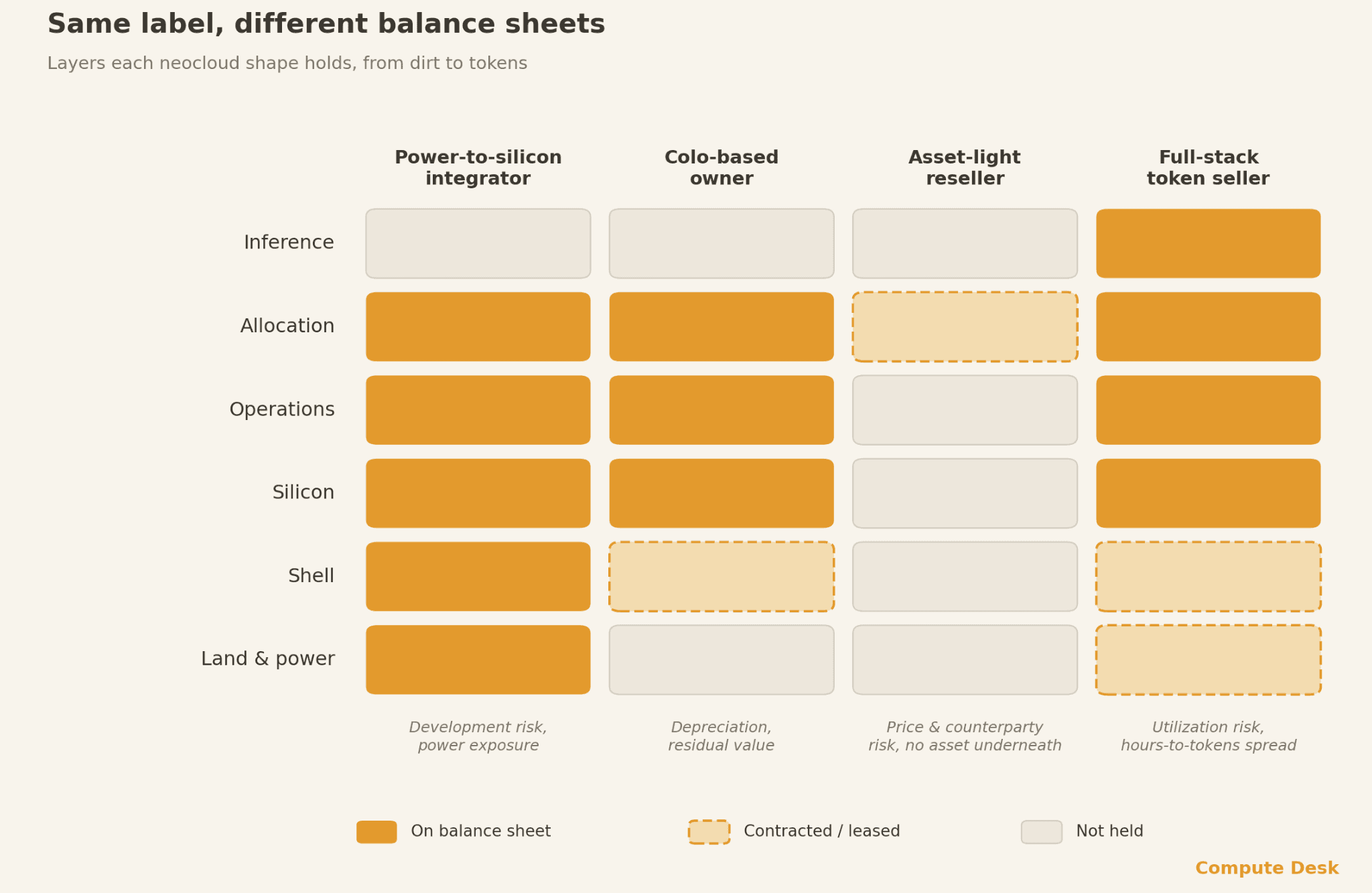
Companies under the label cluster into a few shapes along those layers. The power-to-silicon integrator that controls everything from the substation to the rack. The colo-based owner that leases the building and owns the chips. The asset-light reseller that holds allocation it never touches. The full-stack token seller that runs its own serving stack on capacity it may not own outright, and sells the output. No names: anyone in this market can fill them in.
Each shape carries different risk. The integrator holds development risk and power exposure: years in an interconnection queue before the first dollar of revenue. The colo-based owner holds depreciation and residual value: a bet on what the chips are worth when the first contract ends. The reseller holds price and counterparty risk with no asset underneath. The token seller adds utilization risk and a spread: the gap between the cost of its hours and the price of its tokens.
Today’s shapes are set by lenders, not strategy
The shapes exist because of how the buildout is financed. GPU project debt is underwritten against a single multi-year offtake with a creditworthy counterparty, because the lender has nothing else to underwrite: there is no benchmark to mark a book against and no instrument to hedge the exposure. There is no GPU price, and there is no GPU price hedge. Whoever can sign the longest contract with the strongest counterparty raises the debt, and the debt decides which shapes get built. Shape follows financeability.
The spectrum is not stable
None of these shapes is an equilibrium. Each one exists because the financial layer is missing: with no benchmark, no hedge, and no clearing, every risk stays on the balance sheet of whoever built the asset. A neocloud today is its own broker, its own insurer, and its own clearinghouse, because no one else is there to take those functions. That will change. Next week: which parts of the neocloud playbook become standalone companies.